Friday, January 30, 2015

Spinning Class Handout

Introduction

To say that spinning, the twisting of fibers into a strand, is an art with a long history is like saying there are a couple sheep in New Zealand. Fibers like wool, linen, hemp, jute, nettle, and silk have been used for thousands of years to make yarn, thread, cord, and rope that could be used to make clothing, nets, ship's sails, and even housing. Until the Industrial Revolution normalized machine-spun threads just under two centuries ago, these fibers were spun by hand.

This class will discuss two methods of spinning: European distaff spinning and drop spinning.

Terminology

Spindle: In spindle spinning, the spindle is the item used to twist the fibers into yarn. It also serves as a way to store the spun yarn.

Whorl: The round weight often attached to the spindle as a kind of "fly wheel." It helps keep the spindle spinning when it is suspended.

Shaft: The narrow part of the spindle. The shaft is used for holding the spun yarn and also as a handle. It is the most important part of the spindle, and can be used as a spindle on its own if the whorl is removable.

Roving: The most common way that fiber is prepared for spinning. Roving is formed by carding wool and then drawing it out into a thick rope.

Fleece: "Fleece" most commonly refers to raw wool. "A fleece" refers to the entirety of the wool shorn from a sheep. "A fleece" may have been sorted, or "skirted," but it refers to the whole instead of a portion.

Carding: Carding is the process of brushing wool. It separates the fibers, can remove some tangles, and makes the fiber easier to spin. Carding is relatively new in the history of spinning.

Combing: Combing is the process of using woolcombs to separate fibers. It can be used to remove tangles, short fibers, and foreign matter from wool and other fibers. I have found references to archaeological evidence that shows that wool combing is at least as old as the Viking Age, but it is probably much older.

Ply: Plying involves twisting two or more spun threads together to form a compound strand. It is usually much quicker than spinning single threads.


Drop Spinning

Aside from wheel spinning, drop spinning is the most common form of handspinning in modernized countries like the United States and most spinners today learned how to spin on a drop spindle.

Drop spinning consists of winding yarn around the shaft of the spindle, then securing the yarn at the top. The spindle is suspended from the yarn and given a spin, as if it were a spinning top. The fiber is drafted as the spindle spins and the spindle gets closer to the floor as the spinner drafts more fiber.

In this style of spinning, the ease of spinning and the quality of the yarn can be highly dependent on the weight, shape, and quality of the spindle because the speed and momentum of the spindle affects the speed and duration of the spin, while the weight of the spindle affects how thin the yarn can become before it breaks under the strain.

European Distaff Spinning


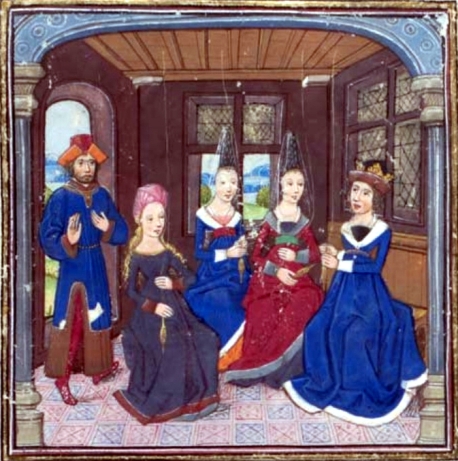
Spinning yarn using a distaff was so predominant in Medieval Europe that so far I have found it impossible to find a definitive medieval image of anyone spinning wool without a distaff. There are some examples that show women spinning without distaffs, but there is no unspun fiber visible, which has left some to conclude that they are plying yarn, not spinning fiber into single strands.

plyingmaybe2

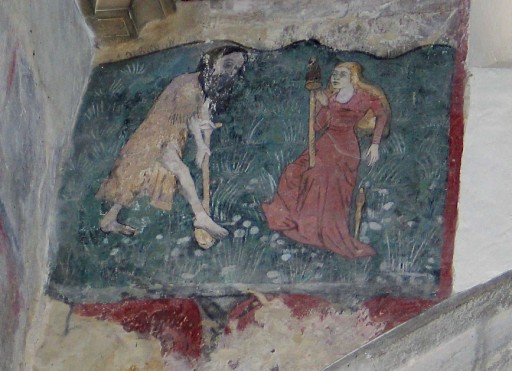
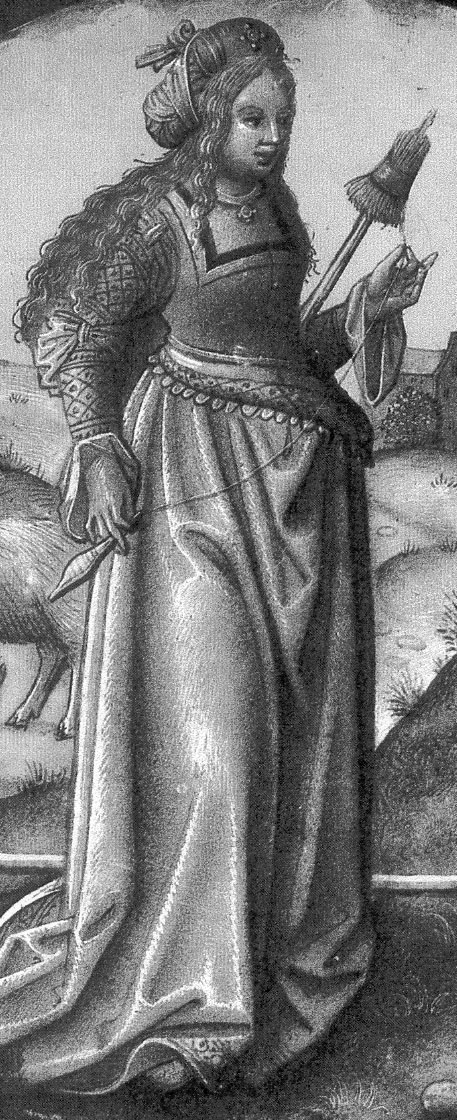
When spinning with a distaff, the unspun fiber is held on a stick (the distaff) that serves almost as a third hand, leaving one hand free to draft the fiber and the other to spin the spindle. The spindle can be rolled between the fingers or dropped, with a half-hitch knot holding the yarn in place. Because the spindle is supported, the shape of the whorl and the weight of the spindle are much less important than they are in drop spinning. Also, the distaff allows for much finer control of the fiber which can allow a spinner to spin fine yarn with relative ease.


15th C broughton church Cambridgeshire


pinterest.com

Sources

International Wool Textile Organization. History of Wool. <http://www.iwto.org/wool/history-of-wool/>.

Elizabeth's Fiber and Yarn Store. Introduction to the Spindle. <http://www.fiber2yarn.com/info/spindle.htm>.

http://upload.wikimedia.org/wikipedia/commons/7/76/Hunterian_Psalter_c._1170_Eve_spinning.jpg

https://15thcenturyspinning.files.wordpress.com/2013/06/15th-c-broughton-church-cambridgeshire.jpg

https://15thcenturyspinning.files.wordpress.com/2013/06/pinterest-com.jpg

Further Reading

The Joy of Handspinning. How to Use a Drop Spindle. <http://joyofhandspinning.com/spinning-yarn-with-a-drop-spindle/>.

Cathelina di Allesandri. 15thCenturySpinning (Blog). <https://15thcenturyspinning.wordpress.com/>.

Else Ostergaard. Woven Into the Earth: Textiles from Norse Greenland. Aarhus University Press. 2004. 

Abby Franquemont. Respect the Spindle. Interweave Press. 2009.

Alex McConnell. The Early Irish Chronicler (Blog). 2015. <http://www.irishchronicler.blogspot.com/>.

The Spindle Project

For An Tir's Twelfth Night 2015, I decided to start a whole new project and do some practical research while I was at it. The Dirty Dozen Largesse Derby provided me with the motivation to make a collection of handmade spindles and discover how they might have been constructed and used. Unfortunately, real life got in the way and I was not able to enter my spindles in the derby, but the project started an investigation into how spinning was done by everyday people before spinning wheels became widespread, and before the Industrial Revolution drastically changed the way textiles were made.

There were a few things I wanted to keep in mind for this project:
-First, it is important to remember that people in the middle ages would have mastered spinning at a very early age. First, since it was a vital skill, spinning was ubiquitous and a normal part of daily life. As such the spinners probably could spin much more nimbly than most people in this century. It was important to remember that certain skills that are difficult for modern people may have been second nature for these lifelong spinners. This is important because it means we cannot discard a technique like using a distaff as improbable just because it feels clumsy to us.
-Second, because spinning was so important, the spindle was first and foremost a tool and not an ornament. There are instances of decorated spindles, particularly in graves, but the vast majority of the spindles made were almost purely utilitarian in nature. They had to be as practical and efficient as possible with the technology and techniques known at the time.
-Third, it is important to discard preconceived notions of what spindle spinning may look like. Most people who spin on spindles today use drop spindles, whether they are top or bottom whorl. Some use supported spindles and other variants, but I'd hazard a guess that at least 90% of spindle spinning done in the 21st century is done on a modern-style drop spindle without a distaff. In order to approach this project with as little bias as possible, I started by completely discarding the idea of a drop spindle. If the evidence pointed me toward the drop spindle as the tool of choice, it would be because the evidence supported it and not because that is the spindle I know best.

So, what was I left with? The most essential basis of what I needed to create was that I needed a tool that could twist wool, linen, etc. into yarn that was good enough and consistently thin enough to be woven into usable fabric. I needed to follow the techniques and tools that we know were available at the time and, when possible, I needed to use the evidence we already have for what spindles looked like and how they were used.

Due to the volume of archaeological evidence, most of the extant pieces (spindle whorls, spindles) I reference here are from the Viking-Age towns of Birka, Kaupang, and Hedeby. For evidence of how spindles were used, I rely primarily on visual evidence from later Medieval illuminations, tapestries, and other artistic depictions. As a secondary source of information, I also reference the design of the spindle whorls as these can indicate the intended method of spinning.

The Materials

The extant spindle whorls from the middle ages show us that they could be made out of a wide variety of materials. In Scandinavia alone we have a body of evidence containing 1356 whorls and 46 spindles dating between the 8th and 15th centuries alone. The whorls are made from amber, antler, bone, clay, coral, glass, metal, lead, wood, and stone(1)(2) and generally weigh between 10 and 30 grams. Diameters cover a wide range that generally can be matched to the density of the material. Soapstone, a heavy stone that is relatively easy to carve, generally was carved into whorls between 3 and 5 centimeters in diameter, though there was one as small as 2cm(1). One could argue that some of the spindle whorls found might have been mislabeled as whorls when in fact they may have been used as beads. This is particularly possible for some of the more precious materials like amber, glass, and coral.

For my spindle whorls, I selected stone and wood in diameters that range between 3 and 5 centimeters depending on shape. Some of the whorls I was able to obtain have more of a donut shape rather than a spherical shape, which means they can have a larger diameter while weighing approximately the same as the spherical versions. It should also be noted that many of the stone whorls are made of semiprecious materials. While plausible, the use of precious stones as spindle whorls is not representative of common Medieval practice and is primarily a result of the materials that were available when I was buying my whorls.

Extant spindles, of which there are fewer, were generally between 7 and 12mm in diameter and 20 to 30cm long(1). I chose diameters that would fit my whorls snugly, which wound up being between 6 and 16mm. My first spindles were cut into 9 inch lengths from a 36 inch dowel, so they were all about 22cm. For the next few, I may cut the dowels into 12 inch lengths for a length of 30cm. My measurements may not necessarily be spot-on, but these spindles will definitely be in the right range.

The Design

The spindles I made were fashioned after medieval drawings and extant spindle whorls. Looking at images of the whorls on display at the museum in Birka (3), the whorls used ranged in shape from semi-spherical to discoid or donut-shaped. My first source mentioned quite a lot of whorls that were flat on one side and convex on the other (planoconvex). I don't see those in the images from Birka, but 37% of the spindle whorls found at Kaupang had this planoconvex shape. Another 29% of the Kaupang whorls were of a conical shape, which evidence suggests would have produced a faster spin, but they do not have much torque so they would be more suitable for wool than for plant fibers(2). Another quarter of the whorls had a regular disc or donut shape. Very few (4 out of 121) of the Kaupang whorls were spherical, which makes sense for a drop-spindling context. Combined with the thick spindle shafts, a spherical whorl would neither spin quickly nor have much torque, though they are quite useful for a style of supported spindling where the spindle is continuously spun between the fingers instead of being spun and left to hang. This type of supported spindling is used in modern Russian support spindles and it is my belief that a variant of Russian supported spindling was one style of spinning used immediately after the spindle was invented, but before drop spindling became the norm.

It looks as though the material of the whorl played a part in determining the shape of the whorl, or vice versa(2). Conical whorls were primarily made from lead or clay, while the discoid an spherical/semispherical whorls were more commonly stone. My guess is that the pliable nature of clay and (possibly) the castable/pliable nature of lead made It easier to form a cone, while stone whorls could be carved or sanded either by hand or lathe into a round shape.

Stone spindle whorls from the museum on the island of Birka, Sweden.
As one can see from the image, the holes in the Birka whorls are rather large in proportion to the size of the whorls themselves. As such, the whorls I used had holes that were as large as possible to accommodate what I imagine were fairly thick spindle shafts. My sources did not seem to indicate that the whorl holes were measured in addition to the extant spindle shafts, but I expect that the holes would closely match the sizes of spindles that were measured.

The design of the spindle shafts posed a greater problem than the design of the whorls. My initial design was based almost entirely off the Russian support spindles because there are so few extant spindle shafts and most artistic depictions of spinning show a mostly full spindle, which makes it difficult to see the underlying shape. However, further investigation yielded a slightly different design. There are a few extant spindle shafts discussed in the book Woven Into the Earth: Textiles from Norse Greenland that are presented in beautifully detailed pictures along with detailed measurements. In contrast to the vaguely conical spindle shape of a modern Russian spindle, these Greenlandic Norse spindles were the same diameter along most of the shaft with a slight bulge near one end that was roughly twice the diameter of the rest of the spindle at its largest point. Also notable is that not all of these spindles showed signs of wear by a whorl, which implies that a whorl was not always necessary for spinning. It should be mentioned, however, that Greenlandic Norse methods of spinning were not always standard, as evidenced by the relative absence of distaffs in the archaeological record and testimony by contemporaries that described Norse Greenlanders as using their heads as distaffs. Despite this regional difference, I would hazard a guess and say that the spindle designs of Norse Greenland did not differ greatly from spindle design in less remote areas.

Lessons Learned

  • Spindle whorls from the Middle Ages took a wide range of forms, but most of them were made of stone or wood, weighed between 10 and 30 grams, and were discoid, hemispherical, or spherical in shape.
  • Spindle shafts from the Middle Ages were usually between 20 and 30 cm long, mostly a consistent diameter, and usually had a bulge of some sort on one end.
  • Hooks on spindles were not unknown, though they were likely not as common as hookless spindles.

Pictures of the Finished Spindles (Upcoming)

Sources

Carolyn Priest-Dorman. Medieval North European Spindles and Whorls. Vassar. 2000. <http://www.cs.vassar.edu/~capriest/spindles.html>.

Ingvild Oye. Textile-Production Equipment. Things from the Town. Artefacts and Inhabitants in Viking-age Kaupang. Ed: D. Skre. Kaupang Excavation Project Publication Series, vol, 3, Aarhus University Press, pp 339-372. <https://www.academia.edu/1168001/Textile-production_Equipment>.

Birka Artifacts. <http://users.stlcc.edu/mfuller/BirkaArtifacts.html>.

Saturday, January 3, 2015

On Wool and Linen (Context is Everything)

I was recently reading Mairead Dunlevy's book Dress in Ireland for a literature review. One of the seemingly inconsequential details that stood out to me is such a small detail that it took me 20 minutes to find it again. This article was originally part of my literature review, but I split it off since it was clear I was no longer reviewing Dress in Ireland, and had some thoughts I needed to get down on paper.

It is mentioned in the "The Sixteenth Century" chapter of Dress in Ireland that it is possible that the custom of using saffron as a dye came to Ireland "from Spain, a hot country where it was used in preventing 'that evil which cometh of much sweating and long wearing of linen'."[1] This was quite an interesting detail to me because it adds a potential extra reason for the prevalence of wool in clothing. Certainly this "evil" that came from wearing too much linen in Spain does not trump the affordability, warmth, and overall practicality of wearing wool in Ireland and other northern countries. That said, it is not unlikely that wool came to be seen as a wholesome material fit for good, sturdy clothing while a more finicky material like linen could bring disease upon the wearer if worn too often. Certainly in an area like Ireland, a person would likely catch a chill in winter if their only clothing were linen. Having a cultural association between wool and wholesomeness would add a dimension to fabric choice and could change the message sent by clothing. To sum up:

Wool:

  • Advantages: cheap, affordable, warm, water-resistant, sturdy, produced locally, wholesome
  • Disadvantages: occasionally uncomfortable, potential association with lower classes

Linen:

  • Advantages: light, softens with age, fashionable, often imported, potential association with upper classes
  • Disadvantages: cold in winter, expensive, less protective, can't wear as often (brings about "evils")
It should be noted that the advantages and disadvantages as categorized here are not set in stone. Locally produced vs imported goods, class association, fashionability, and affordability are all characteristics that may or may not be preferred by certain groups. Most of the people I know, for example, prefer locally-produced sturdy clothing over fashionable imports because they want to be seen as hard-working, practical people who support the local or national economy. In other circles, imported fashions and expensive tailoring are preferred because they show that the wearer is able to afford such things. In late medieval Ireland, wearing English or Irish styles became a political statement that showed the wearer's acceptance or rejection of English rule.

The "evil which cometh of [...] much wearing of linen" gave me a strong reminder of how important it is to consider context when studying fashion. Fashion is so closely tied to culture that it is arguably impossible to fully understand without a strong knowledge of the culture (and subculture) that wore it, in addition to things like history, origin, and how that culture and its groups viewed the fashion. Imagine if, in 400 years, someone concluded that people all over the world in the late 20th century all wore ripped black clothing covered in decorative safety pins. It would be an example of a unique subculture's fashion trend, in this case punk culture, being mistaken as the prevalent or accepted fashion of an entire society, completely ignoring the specific message sent by such a trend. Thus, I restate this as much for myself as for anyone else: context is everything!


[1] Dunlevy pg 54. Originally sourced from Edmund Spencer's A view of the State of Ireland written dialogue-wise between Eudoxus and Irenaeus, intro., James Ware, Marlborough, 1809, pp.101

Saturday, December 27, 2014

Learn to Spin (with a Medieval flare) Class description and Lesson Plan

Name: Learn to Spin (with a Medieval Flare)
Class Fee: $5 to cover materials
Location: North Plains Senior Center, North Plains OR
Time: 1-3pm, Saturday January 31, 2015
Duration: 2 hrs
Limit: 6 students*

Class description: In this class, we will cover the essentials of spinning: tools, technique, and fiber. We will begin with a short lesson on how spinning was done in the Early Medieval period with a focus on Norse spindles and wool. Students will be presented with pictures of medieval spinners to better examine what spinning would have looked like in the Middle Ages, and we will briefly examine pictures of extant spindle whorls and data from three archaeological digs in Scandinavia. A discussion of fibers will follow, then a lesson on how to use a drop spindle with wool roving. The lesson will focus on the use of a bottom-whorl drop spindle and modern spinning techniques with discussion on how modern techniques differ from the medieval techniques. The lesson will conclude with a brief demonstration of spinning using a period spindle and a distaff. Students will take home one bottom-whorl drop spindle, some wool roving, and a printed information pamphlet with resources for further study if desired.

* Children 12 and under must be accompanied by an adult (single fee unless both are taking the class).

Saturday, November 22, 2014

Literature Review: Costume 1066-1966 A Complete Guide to English Costume Design and History by John Peacock

Hi folks! I promised that the next literature review would be the latter part of Mairead Dunlevy's Dress in Ireland, but I'm still working my way through it and its later chapters are much denser than I anticipated. So, in lieu of Dress in Ireland's part II, I present a review of an overview-style book.

This is a book that I picked up from my university's library with the hope that it would help me with my thesis. Unfortunately, its time period wound up not matching with the era I was looking at, but I've kept it around for general reference and because getting a huge stack of books back to campus is like, super hard you guys. Anyway, it's due in January and I really should return it then since I'm no longer a student, so I figured I'd flip through it. Let me tell you, I was well rewarded.

Costume 1066-1966 takes the form of a sketchbook with informative notes, which for me was extremely helpful. Recently I read a book on European fashion* that started as far back as the Minoan culture and ended somewhere around the end of the Renaissance, if memory serves me properly. This particular book was chock-friggin-full of information but had very few images. It covered fashion trends down to about the span of a decade on average, with detailed descriptions of each style with references to any "retro" fashions that came back into style. It really was very informative, but it left my head spinning with all the information it presented. I am not a part of the fashion world, so even specialized terminology left me without a good idea of how these styles would have actually looked. A gable headdress? Sure, I know that thing.

The great part about Costume 1066-1966 is that it is almost entirely pictures. It presents styles chronologically and labels them according to the King or Queen at the time. It also presents both men's and women's fashions, with an occasional page dedicated to external clothing, like mantles, that would have obscured the other garments. In later parts of the book, notes are made as to the occasion at which a garment would have been worn. For example, "winter coat" or "ball gown." I also find the notes to be extremely useful. Sometimes in an image it can be difficult to discern the important parts of an image, or even whether a particular feature is correct or just an artistic detail. In this book, important features are highlighted for the reader, such as "side lacing," "embroidered cuffs," and "padded sleeves."

The only gripe I might have is that when the edges on a gown or tunic are supposed to be decorated with a woven band, they seem too wide. I have not yet been able to find any evidence of tablet woven bands that are any wider that 1", and even that is pushing it. Most of the bands I've seen are around 1/4-1/2", while the edges depicted in the book look closer to 1.5"-2". While this is a small detail, it could be quite important when this book is used for its intended purpose: visual reference. It also makes me question somewhat the accuracy of the later sketches, but I don't have enough expertise to make that call.

Overall, I would recommend this book highly as a companion reference, particularly if it is paired with a more detailed, wordy book like the text mentioned above. It provides a great overview of fashions over the course of 900 years, which is no mean feat. I have also found that it is a great book to read once at the beginning of research and revisit often. It's a great book for quickly getting the "feel" of a fashion and for understanding the styles that came before it, to better put it in context.

*I'll post the title of the book once I find it in my local library again

Monday, November 10, 2014

Literature Review: Dress in Ireland: a history by Mairead Dunlevy (Part 1 of 2)

This is the second installment in what will be an ongoing series of literature reviews. The first was on H.F. McClintock's Old Irish and Highland Dress, which I tore apart with rather less mercy than others may have done. Since my knowledge on Dress in Ireland tapers off drastically after 900CE, I cannot say as much about the latter portion of the book. I also more or less skipped the second half of the book because it was on fashions from the eighteenth century onward and I wasn't interested, but I am sure that the quality of the book gets better and better as more evidence became available to the author.

I also wrote a small article on a particular detail on the use of linen in the Sixteenth century. You can read that article here.

For anyone who read my thesis (available here), you may have noticed a conspicuous lack of reference to the works of Mairead Dunlevy and H.F. McClintock. This was not an accident! In my research, I noticed that many of the articles available on medieval Irish dress referred to one or both of these resources and even those that didn't refer directly to them used remarkably similar language and made very similar arguments as those that did. It seemed like a lot of the current research referred back to these sources in some way. One of my original goals when writing my thesis was to see what other resources were out there, which is part of the reason why the title includes the phrase "Re-Examining the Evidence." I simply wasn't satisfied with the current body of available knowledge, and particularly the tendency to go back to just a handful of sources. I have already reviewed Old Irish and Highland Dress by H.F. McClintock, but I took the plunge on the recommendation of a friend and bought a copy of Dress in Ireland: a history(1987) by Mairead Dunlevy. While this comes too late to make it into my thesis, I was hoping that the book could give me a better basis for my research and possibly provide me with more artifacts that I could research directly. In the former I was disappointed, but in the latter I was pleasantly surprised.

First off, let me say that Dress in Ireland is full of assertions that are based on art and artifacts, which is fantastic. The first pages of chapter 1 greet you with detailed photographs of artifacts from the first century BCE, found by a farmer in Co. Armagh. In these photographs you can see relevant details such as decoration, weave structure, and what joining techniques were left visible when the artifact was made. There is a shoe that prominently displays repair and sophisticated structure and two horsehair belts with weave structure visible as well as intricate fringes. The artifacts, along with a couple not pictured, are synthesized into a picture of what the wearers may have looked like in these garments. This is great! A+ to Dunlevy on the BCE portion of her book and the presentation of her evidence.

I will also say that this is the most complete collection of knowledge on Irish dress that I have encountered so far. Unfortunately, it has been cited to death and I had heard almost everything before. Had it been the first source I read, it would have given me the essential knowledge base that I craved when I started my research, which began even before I started my thesis. For that, I commend Dunlevy and I wish I had found this book years ago.

It's time for my complaints. Like McClintock, Dunlevy seems to treat the first millennium CE as a relatively static period, and jumps from the first centuries (both BCE and CE) up to the 8th, 9th, and even 10th centuries like it ain't no thang. What about the introduction of Roman culture? She acknowledges the possible influence of the Romans on the Irish and that Roman styles might have been incorporated into Irish dress, but never details what these changes might be and never really acknowledges it after that, even as a style of pants from the later centuries are described as possibly hearkening back to 100 BCE. I agree that it's possible that it was a deliberate revival of the old styles, but I'm more inclined to believe that practical styles of pants in a given region have a somewhat limited range of possible styles (pumpkin pants excluded - there's no accounting for pumpkin pants ;)).

It is also sometimes odd to hear Dunlevy's interpretation of various artifacts. I mentioned the repaired shoe above. Dunlevy believes that it was cut into shape from a single piece of leather. With my experience in sewing and leatherwork, I don't see how this particular shoe could have been constructed from only one piece of leather. I will grant that shoes made from one piece of leather were known in Ireland, and I even used the 10th century Drumacoon bog shoe as a pattern for the shoes that went along with my thesis dress. They're fantastic and I love them, and I absolutely believe one-piece shoes were a thing in Ireland at that time. However, the images provided in the book do not indicate a single-piece shoe. There are clearly seams that indicate that the top of the shoe was cut separate from the sides and sole, then the top was sewn onto the main portion. Maybe there are details that are not visible in the image that prove it was from a single piece of leather, but there's no way to tell from the given evidence. There is a smattering of things in the first few chapters that, similar to the "single piece" leather shoe, just don't make sense, so I take issue with it.

The latter part of Dress in Ireland was quite enjoyable in my opinion. As one might expect, the prevalence of extant pieces increased as the timeline progressed, giving more and more (aged, of course) examples of what dress actually looked like in a given time period. Occasional details were lost in the actual clothing articles, such as color schemes and what some hems would have looked like, but for the most part those could be filled in with artistic representations of clothing, which were presented alongside the actual clothes to give a more complete image.

I also really enjoyed the excerpts from contemporary literature that stated details like attitudes toward the new fashions from contemporary perspectives and prices of materials and tailoring service along with the occasional inventory of a person's garments. While I was researching my thesis, these were questions that I desperately wished I could answer because they help me figure out a garment's place in society. Did someone have lots of clothing options? Did they rely on a single outfit for their daily needs? Were certain styles seen as practical or frivolous, or modest or indecent? Which materials were produced locally and which had to be imported? Since fashion is affected by all of these factors, it is important to know these contextual details in order to form a more complete idea of how a fashion could have arisen, which groups would have worn it, and what kind of message it would have sent to other members of a culture. With information like this, it was easier for me to grasp how people of various groups, genders, economic backgrounds, and political and religious affiliations were dressing.

In the sixteenth century chapter, I particularly enjoyed the gown found in Shinrone bog and decided to emulate it in linen for An Tir's Twelfth Night 2015. While not entirely accurate (for one, the whole thing was done in a week of evenings on a sewing machine), it was a great chance to explore late Medieval construction and Irish styles.

Complaints aside, this is a great book to get an introduction to what we currently know about Irish dress in the Early Medieval Period. If you are coming straight into learning about dress in Ireland, pick it up ASAP. It's one of the most commonly cited resources for the topic and I guarantee you that it will save you hours of wasted time on the Internet trying to find reliable sources.

Monday, October 20, 2014

Literature Review: Old Irish and Highland Dress by H.F. McClintock

This is the first installment of what will likely be an ongoing series of literature review posts. They will include my notes, impressions, questions, and other musings on books that I read for my research. While they are primarily for my own use, perhaps you will find them useful in hearing about various resources that are available.

Hoo boy, this one will be fun. For anyone who read my thesis (available here), you may have noticed a conspicuous lack of reference to the works of Mairead Dunlevy and H.F. McClintock. This was not an accident! In my research, I noticed that many of the articles available on medieval Irish dress referred to one or both of these resources and even those that didn't refer directly to them used remarkably similar language and made very similar arguments as those that did. It seemed like a lot of the current research referred back to these sources in some way. One of my original goals when writing my thesis was to see what other resources were out there, which is part of the reason why the title includes the phrase "Re-Examining the Evidence." I simply wasn't satisfied with the current body of available knowledge, and particularly the tendency to go back to just a handful of sources. While I ran out of time to examine Dress in Ireland for my thesis, I was able to obtain Old Irish and Highland Dress (1943), the definitive book by H.F. McClintock that discusses Irish dress from the BC era to around the 1700s (if my memory serves me properly). Due to my area of interest and expertise, I primarily reviewed the section on early Irish dress, not the more recent styles.

To say the least, I was disappointed. Sure, it presented some evidence and made an argument, but it fell into the trap of looking at the first millennium CE as a relatively static period. A major source of its evidence is a single version of the Tain bo Cuailnge and the garments described therein. While many of the Irish epics were written down circa the 8th century CE, these were by no means new stories. Ireland has an ancient oral tradition and its storytellers have a long memory. Even today one can find renditions of the old epics as recorded from people who learned them from other storytellers, not from books[1]. By McClintock's logic, someone who read a book written in the 20th century that was a collection of Irish epic tales could rightly conclude that people in Ireland in the 20th century were likely wearing something similar to what is described in the tales, assuming no other evidence were available. That is to say, the average Irish person in the 20th century would be wearing a leine, a brat, and a gold or silver brooch among other garments. This is the heart of my objection to McClintock's work: an entire millennium is nothing to be overlooked. While these stories might depict dress in the 8th century, I find it more plausible that they depict the strongly Celtic dress and culture of a much earlier time, i.e. the first century BCE, an era that has produced many more artifacts of metalwork and even clothing that more closely resembles what the Tain describes[2]. This website, while not a spectacular source, gives a good overview of early Celtic clothing, though I would argue against the use of a separate top and skirt in the female peasant's outfit. Notice that the time period given for those styles starts at 600 BCE and ends in 100CE, much earlier than the 8th century CE.

That's about all I can say for Old Irish and Highland Dress. It covers quite a bit more material, but since my focus is on pre-Norman Irish dress, I'm going to leave the bits on later dress up to your own interpretation. I also had the book through interlibrary loan and had to give it back over a year ago, so I don't remember much detail for the parts that weren't directly relevant to my thesis. I will say that I thought McClintock did a better job of documenting his assertions for the later styles, but he tends to reference English sources. It is well-known that there was a tendency by the English to view the Irish as barbaric, so I would take what the English say about Irish dress with a big ol' grain of salt.

If you are interested in doing further research on early Medieval Irish dress, I won't discourage you from reading this book. It is, after all, a staple reference for Irish dress and I would consider it an important book to read. However, I see many flaws in its evidence, methods, and assertions and I would recommend reading it more to understand where many of our current ideas about Irish dress came from, rather than an actual resource to enhance your knowledge of Irish dress itself.

[1] Colum, Padraic. A Treasury of Irish Folklore: the stories, traditions, legends, humor, wisdom, ballads, and songs of the Irish people / edited with an introduction by Padraic Colum. 2nd rev. ed. New York: Bonanza Books : Distributed by Crown Publishers, 1983, c1967.

[2] Vassar's Website with text of the Tain bo Cuailnge